
Refrigerators are essential appliances in our homes, running 24/7 to keep our food fresh. But have you ever wondered how much electricity they use?
In this guide, we’ll answer the question “how many watts to run a refrigerator?” so that you can optimize your energy consumption. We’ll also help you find alternative ways to keep your icebox running in case of a power outage.
How Many Watts Does a Refrigerator Use?
Most modern, standard size refrigerators (20 to 25 cubic feet) in the United States use 34 to 91 watts (W) of continuous power; 300 to 800 watt-hours (Wh) of daily energy; and 300 to 800 kilo watt-hours (kWh) of electricity annually. Modern refrigerators are more energy-efficient than older models, using less power on both a daily and annual basis.
Here’s the breakdown:
Refrigerators made post – 2000 (20–25 cu. ft.)
- Continuous Power:
34 to 91 watts (W) average continuous power. - Daily Power:
822 to 2,192 watt-hours (Wh) per day. - Yearly Power:
300 to 800 kilowatt-hours (kWh) per year.
Refrigerators made pre – 2000 (20–25 cu ft)
- Continuous Power:
100 to 400 watts (W) average continuous power. - Daily Power:
2,400 to 9,600 watt-hours (Wh) per day. - Yearly Power:
876 to 3,504 kilowatt-hours (kWh) per year.
Summary Table
| Refrigerator Type | Continuous Power (W) | Daily Energy (Wh) | Yearly Power (kWh) |
|---|---|---|---|
| Modern (post-2000) | 34 – 91 | 822 – 2,192 | 300 – 800 |
| Older (pre-2000) | 100 – 400 | 2,400 – 9,600 | 876 – 3,504 |
Quick Tip: The easiest way to check how many watts your refrigerator uses is to simply look inside – the watts should be listed on the interior of the fridge wall.
Because refrigerators cycle on and off throughout day, their true energy consumption is usually lower than their stated wattage.
Source: Federal Register
Understanding Refrigerator Power Consumption
- Starting Watts: This is the power surge that happens when the compressor first turns on. Starting watts are usually 2-3 times higher than the running watts.
- Running Watts: This is the continuous power needed to keep the refrigerator operating once it’s started.
A refrigerator might need up to 2,400 watts for a brief moment when starting up.
Refrigerator wattage by brand, size, and usage
Below is a breakdown of a refrigerator’s power consumption and annual costs for common models:
| Brand | Size (Cu. Ft.) | Avg. Watts (Running) | 1 Hour | 12 Hours | 24 Hours | Annual Cost* |
|---|---|---|---|---|---|---|
| General Average | 18-22 | 167-500 | 0.17-0.5 kWh | 2-6 kWh | 4-12 kWh | $180-450 |
| Frigidaire | 20 | 150 | 0.15 kWh | 1.8 kWh | 3.6 kWh | $235 |
| GE | 19.1 | 117 | 0.12 kWh | 1.4 kWh | 2.8 kWh | $195 |
| LG | 20.2 | 133 | 0.13 kWh | 1.6 kWh | 3.2 kWh | $227 |
| Beko | 20.9 | 190 | 0.19 kWh | 2.3 kWh | 4.6 kWh | $321 |
| Bosch 800 | 20.5 | 194 | 0.19 kWh | 2.3 kWh | 4.7 kWh | $326 |
| Thermador | 20.8 | 195 | 0.20 kWh | 2.4 kWh | 4.8 kWh | $330 |
Notes:
How to Calculate Your Refrigerator’s Wattage
To find out exactly how many watts your refrigerator uses, you have several options:
- Check the EnergyGuide Label: Look for the yellow EnergyGuide label on your refrigerator. It shows the estimated annual energy consumption in kilowatt-hours (kWh).
- Look Inside the Refrigerator: Many models have a label inside with power specifications.
- Consult the User Manual: The manual often includes detailed power consumption information.
- Use a Wattage Meter: For the most accurate measurement, plug your refrigerator into a wattage meter to monitor its actual power consumption over time.
Daily Energy Usage
Wattage (W) × Hours Used Per Day / 1000 = Daily Energy Usage (kWh)
- Example: If your fridge averages 150 W and runs for 8 hours/day: (150×8)/1000=1.2 kWh per day
Monthly Energy Usage
Daily Energy Usage (kWh) × Number of Days in Month = Monthly Energy Usage (kWh)
- Example:
36 kWh/month × $0.15/kWh = $5.40 per month
Yearly Energy Usage
Daily Energy Usage (kWh) × 365 = Yearly Energy Usage (kWh)
- Example:
1.2 kWh/day × 365 = 438 kWh per year
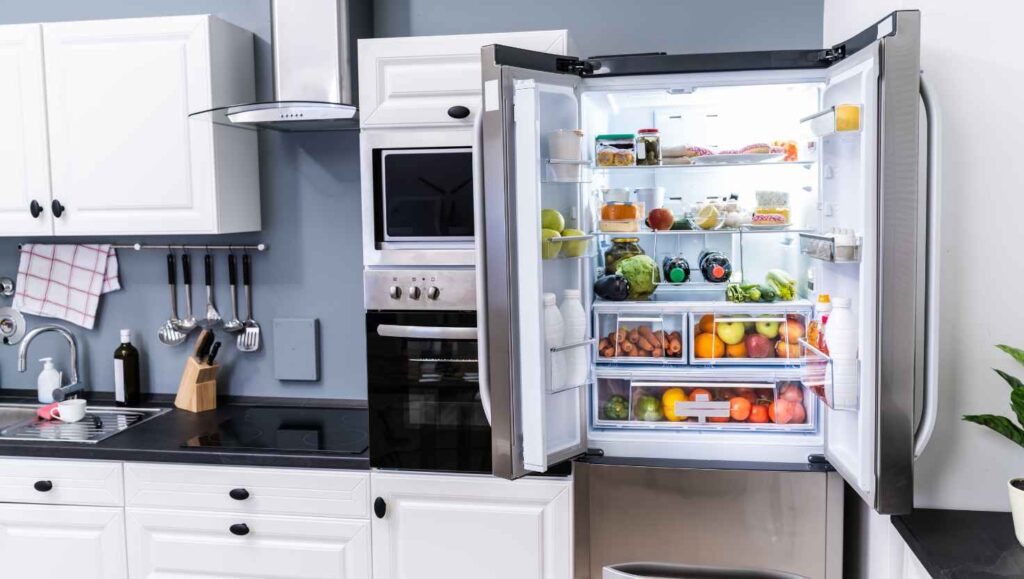
How to Calculate Your Refrigerator Energy Costs
Daily Energy Cost
Daily Energy Usage (kWh) × Electricity Rate ($/kWh) = Daily Energy Cost
- Example:
1.2 kWh/day × $0.15/kWh = $0.18 per day
Monthly Energy Cost
Daily Energy Usage (kWh) × Number of Days in Month = Monthly Energy Usage (kWh)
- Example:
36 kWh/month × $0.15/kWh = $5.40 per month
Yearly Energy Cost
Yearly Energy Usage (kWh) × Electricity Rate ($/kWh) = Yearly Energy Cost
- Example:
438 kWh/year × $0.15/kWh = $65.70 per year
Note:
Factors Affecting Refrigerator Power Consumption
Several factors can influence how many watts of power your refrigerator uses:
- Power (watts): The energy consumption of your refrigerator when running, measured in watts (W).
- Size and Model: The brand, dimensions, and age of your refrigerator.
- Compressor Efficiency: This is the most energy consuming part because it maintains the internal temperature, usually between 40 and 35 degrees.
- Daily Hours: The number of hours your refrigerator runs each day, typically between 8 to 12 hours.
- Usage: The frequency of opening and closing the refrigerator door, which can increase energy consumption.
- Room Temperature: The indoor temperature of your home. Refrigerators work harder (and use more power) in warmer environments.
- Food Storage: The amount of food stored inside the refrigerator impacts how many cooling cycles it needs.
- Your Electricity Rate: The cost of electricity per kilowatt-hour (kWh), which varies depending on your location and utility provider.
How Refrigerator Power Use Impacts Your Electric Bill
A refrigerator is one of the most energy-consuming appliances in most people’s home. Although it’s not the highest consumer of electricity compared to appliances like air conditioners, space heaters, and water heaters.
How Does Refrigerator Energy Use Compare to Other Appliances?
| Appliance | % of Home Electricity Use | Notes |
|---|---|---|
| Air Conditioning | 16% | Highest in most homes2 |
| Space Heaters | 15% | |
| Water Heaters | 12% | |
| Refrigerator | 6–10% | Runs 24/7, one of the top energy users1258 |
| Lights | 4% | |
| TV & Consoles | 4% | |
| Computer | 2% |
Compare Two Fridges:
| Fridge Type | Watts | Daily Runtime | Yearly Cost* |
|---|---|---|---|
| Old Fridge | 700W | 10 hours | $357.70 |
| ENERGY STAR Fridge | 350W | 8 hours | $143.08 |
Savings: $214.62/year with an efficient fridge.
(Based on U.S. average rate of $0.14/kWh)
Easy Ways to Save on Refrigerator Power Consumption
- Buy ENERGY STAR: Saves 15–20% on energy.
- Set Temperatures Right: 37°F for the fridge, 0°F for the freezer. Every 5°F colder adds 25% to your bill!
- Clean the Coils: Dusty coils make your fridge work harder, wasting 30% more energy.
Cost Examples
| Fridge Power | Daily Runtime | Yearly Cost (U.S.) |
|---|---|---|
| 150W | 8 hours | $61.32 |
| 300W | 10 hours | $153.30 |
| 600W | 12 hours | $367.92 |
How to Calculate Your Energy Costs
Once you know your refrigerator’s wattage, you can estimate its energy costs. Here’s a simple calculation:
- Convert watts to kilowatts by dividing by 1,000.
- Multiply by the number of hours used per day (typically 24 for a refrigerator).
- Multiply by your electricity rate (in dollars per kWh).
- Multiply by 365 to get the annual cost.
For example, if your refrigerator uses 167 watts on average:
- 167 watts ÷ 1,000 = 0.167 kW
- 0.167 kW × 24 hours = 4 kWh per day
- 4 kWh × $0.13 (average U.S. electricity rate) = $0.52 per day
- $0.52 × 365 days = $189.80 per year
Energy Efficiency and ENERGY STAR Ratings
When shopping for a new refrigerator, pay attention to ENERGY STAR ratings. ENERGY STAR certified refrigerators use about 15% less energy than non-certified models. This can translate to significant savings over the appliance’s lifetime.
To compare the efficiency of different models, look at the EnergyGuide label. It shows the estimated annual energy consumption and operating cost, making it easier to choose an energy-efficient option.
Household Size Recommendations
While there’s no official formula linking refrigerator capacity to household size, practical guidelines help optimize energy use. Below, we break down how cubic footage impacts wattage efficiency and provide actionable recommendations for different living situations.
Recommended Fridge Capacity by Household Size
| Household Size | Ideal Capacity | Average Wattage | Key Considerations |
|---|---|---|---|
| 1–2 people | 10–18 cu. ft. | 300–400W | Compact models with inverter compressors (e.g., TCL P503SB)47 |
| 3–4 people | 18–22 cu. ft. | 400–600W | ENERGY STAR® units reduce wattage by 15–30%59 |
| 5+ people | 22–28 cu. ft. | 600–800W | French-door designs minimize cold air loss8 |
Factors Influencing Wattage Efficiency
1. Insulation Quality
- Modern refrigerators with thicker insulation (e.g., LG InstaView) use 20% less energy than older 25 cu. ft. models.
- Glass freezer shelves trap cold air better than wire racks, reducing compressor cycles.
2. Compressor Type
- Inverter compressors: Adjust speed based on cooling demand, using 40% less energy than fixed-speed models.
- Dual compressors: Separate systems for fridge/freezer prevent overcooling (common in 22+ cu. ft. units).
3. Temperature Zones
- Specialty drawers (humidity-controlled crispers, deli compartments) add 50–100W but reduce food waste.
Case Study: 2-Person Household Efficiency
- Need: 12 cu. ft. capacity for weekly groceries.
- Solution: Galanz GLR12TRDEFR (340W) vs. standard 18 cu. ft. model (450W).
- Savings:
- 110W difference × 8 daily compressor hours = 0.88 kWh/day saved.
- Annual savings: 321 kWh (~$45 at $0.14/kWh)
4 Tips to Match Capacity Needs with Efficiency
- Prioritize vertical space: Taller 18 cu. ft. models (e.g., Midea MTHSJ-1802) use 350W vs. 400W for wider units.
- Avoid oversized freezers: Frost-free freezer compartments add 100–150W; opt for manual defrost in smaller units.
- Check kWh/year labels: A 14 cu. ft. fridge using 300 kWh/year = ~34W average hourly draw.
- Use modular solutions: Pair a 10 cu. ft. fridge (300W) with a 3.5 cu. ft. freezer (100W) for flexible, efficient cooling
Preparing for Power Outages
Given that refrigerators are crucial for food safety, it’s wise to have a backup power plan for outages. Here are some options:
- Portable Power Stations: These battery-powered units are clean, quiet, and can be used indoors. They’re ideal for short-term outages.
- Portable Generators: Gas-powered generators offer more power but must be used outdoors due to exhaust fumes. They’re better for longer outages.
- Whole-House Generators: These automatically kick in during an outage but require professional installation and are more expensive.
- Solar Panels with Battery Storage: While costly upfront, this option provides long-term energy independence and can power your entire home.
Best Portable Power Stations for Running a Refrigerator
Based on our analysis of the search results and considering factors like power output, capacity, and user reviews, here are some of the best portable power stations for running a refrigerator:

- 30% Tax Credit Could be Applied. You could apply for…
- Large Capacity. Featuring a 3600Wh LFP battery…
- Maximum Output Flexibility. A single DELTA Pro unit…
- X-Stream Fast Charging. Fully recharge the lifepo…
- 5 Ways to Charge. Pick from EV station charging, solar…


- High-Capacity Power Solution: With 3 AC ports…
- Smallest & Lightest 2kWh Power: Weighing just 39.5 lbs…
- Ultra-Fast & Versatile Charging: Power up and go…
- Durable for 10 Years: The Jackery Explorer 2000 v…
- Whisper-Quiet Operation: The Jackery Explorer 2000 v…

- Power. Anything. Anywhere. This portable backup power…
- 10 Versatile Ports, 1,516 Wh Capacity: Power most small…
- Durable Construction, Safe Electric & Solar Power: With…
- Recharge with Solar & Unlock Indefinite Power: Turn…
- This Is Goal Zero: Inspired by passion for adventure…
No products found.

- [2600W Continuous & 3900W Power Lifting] – With…
- [Less Waste, More Usable Power] – An advanced energy…
- [Longest Lifespan of 17-Year] – Equiped with the…
- [Adjustable Fast Charging & Ultra-Quiet] – Choose from…
- [Ultra-Fast & Smart Recharging] – Equipped with BLUETTI…
Frequently Asked Questions
Are there differences in wattage between refrigerators from different manufacturers?
Yes, there are notable differences in refrigerator wattage between manufacturers due to variations in technology, design, and energy efficiency standards.
Wattage Comparison by Brand
| Brand | Model Type | Average Wattage | Annual Energy Use (kWh) |
|---|---|---|---|
| LG | 20.2 cu. ft. (ENERGY STAR) | 133W | 400 kWh |
| GE | 19.1 cu. ft. (ENERGY STAR) | 117W | 350 kWh |
| Frigidaire | 20 cu. ft. (ENERGY STAR) | 150W | 450 kWh |
| Beko | 20.9 cu. ft. (Standard) | 190W | 565 kWh |
| Bosch | 20.5 cu. ft. (Standard) | 194W | 568 kWh |
- Cost Difference: A 150W fridge costs ~$61/year to run, while a 500W model costs ~$367/year (U.S. average).
- Efficiency Leaders: LG, GE, and Frigidaire lead in low-wattage models because of their inverter compressors and smart sensors.
- Avoid High Consumers: Non-certified brands like Thermador or Bosch (non-ENERGY STAR) often exceed 500W.
What are the most energy-efficient refrigerator brands available today?
If you’re looking for the most energy-efficient refrigerator brands and specific models available today, ENERGY STAR certification is the gold standard. These models combine modern technology, smart design, and advanced insulation to deliver top-tier efficiency.
| Brand Model | Style | Size | Avg. Running Watts* | Annual Energy (kWh) |
|---|---|---|---|---|
| Samsung RT18M6215 | Top Freezer | 17.6 cubic feet, 29 inch width | 153 | 448 |
| Samsung RF30BB6602 | 3-Door, French Door | 30 cubic feet, 35 inch width | 186 | 545 |
| Whirlpool WRT112CZJW | Top Freezer | 11.6 cubic feet, 24 inch width | 221 | 646 |
| GE GSE25G | Side-by-Side | 25.3 cubic feet, 35 inch width | 221 | 646 |
| LG LS27T3230S | Side-by-Side | 27.2 cubic feet, 35 inch width | 230 | 670 |
| LG LRFCS25D3S | 3-Door, French Door | 25 cubic feet, 33 inch width | 230 | ~670 |
| Samsung RF29DB990012 | 4-Door, French Door | 18 cubic feet, 33 inch width | 240 | 700 |
| KitchenAid KRFC302ESS | 3- Door, French Door | 22 cubic feet, 36-Inch Width | 247 | 720 |
Can a portable power station run a refrigerator?
Yes, a portable power station can run a refrigerator, but you need to choose one with sufficient capacity. Look for a power station that can handle both the running watts and starting watts of your refrigerator. For most household refrigerators, a power station with at least 1,500 watts of output and 1,000 watt-hours of capacity should suffice for several hours of operation.
How long can a portable power station run a refrigerator?
The runtime depends on the capacity of the power station and the power consumption of your refrigerator. As a rough estimate, a 1,000 watt-hour power station could run a 167-watt refrigerator for about 6 hours (1,000 Wh ÷ 167 W = 5.99 hours). However, this is a simplified calculation, and actual runtime may vary due to factors like starting watts and cooling cycles.
What size generator do I need to run a refrigerator?
For most standard refrigerators, a generator with at least 2,000 watts of running power and 3,000 watts of starting power should be enough. This allows for the high starting watts and provides some extra capacity for other appliances. However, if you’re only powering a mini-fridge or RV refrigerator, a smaller 1,000-watt generator might work.
How can I reduce my refrigerator’s power consumption?
To lower your refrigerator’s energy use:
- Keep the coils clean and free of dust.
- Ensure proper ventilation around the refrigerator.
- Set the temperature to the manufacturer’s recommended level.
- Minimize the time the door is open.
- Let hot foods cool before refrigerating them.
- Consider upgrading to a more energy-efficient model if yours is old.
Related Topics:
- How to Build a Solar Camping Heater: A Safe and Eco-Friendly Way to Stay Warm Outdoors [Eco Friendly Gear]
- 5 Best Portable Power Stations for Eco Camping
- What are the best portable power stations for emergency EV charging?
- How to Choose the Right Portable Power Station Battery Capacity
- Portable Power Station Outlet Guide & Compatibility
- How to choose a portable power station for home use – a comprehensive guide
- 4 Awesome Portable Power Stations for Home Use
- Portable Power Station Maintenance Guide: Tips & Tricks
- Top rated portable power stations according to the experts
- How Lithium-Ion Batteries and Solar Power are Changing the Game
Conclusion
Understanding how many watts your refrigerator uses is important to preparing for power outages. While most household refrigerators use between 300 to 800 watts, their actual consumption is often lower due to cycling. If you choose an energy-efficient refrigerator and pair it with an adequate portable power station, you can make sure that your food stays fresh and safe, even when the power grid goes down.